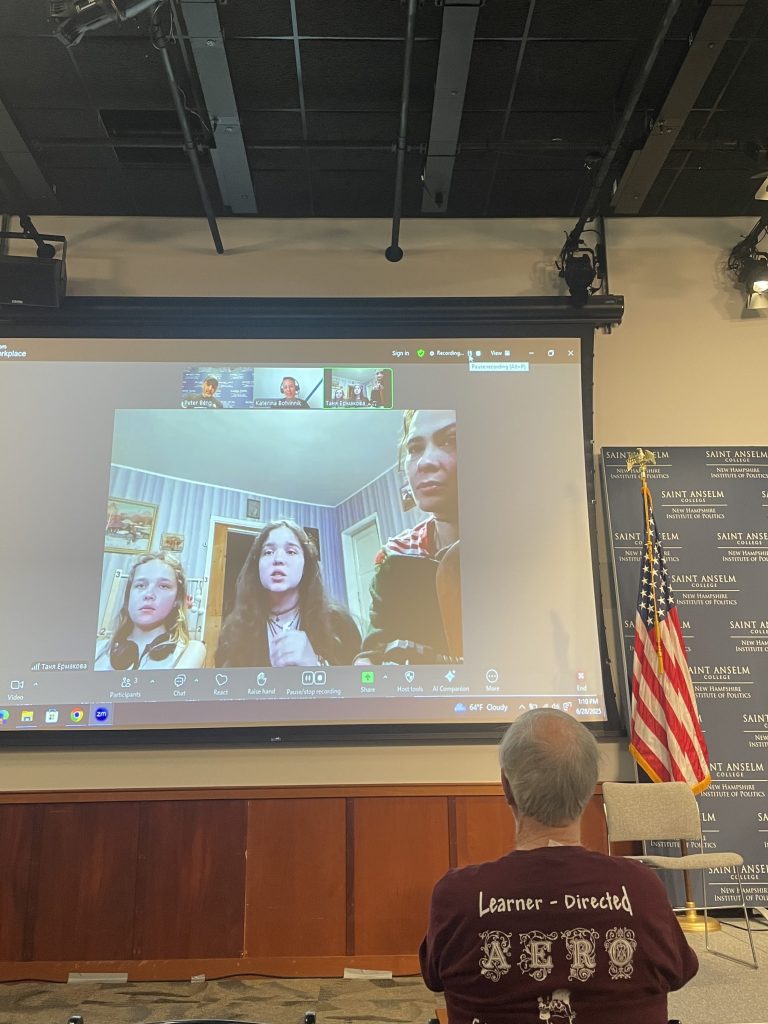
A powerful conversation at AERO 2025 with educators and youth from One Crazy School in Vinnytsia, Ukraine
In a world where education often focuses on test scores and academic achievement, what happens when war strips away everything except what truly matters? This question came into sharp focus during a recent virtual presentation featuring Kateryna Botvinnik and Daria Gorobets from One Crazy School in Vinnytsia, Ukraine, along with two remarkable young people from their community.
When Everything Breaks, Community Remains
“In a war you don’t have a foundation of safety, so the next best thing you can rely on is community,” shared Kateryna, one of the school’s founders. “That is the only thing that you have. Everything else is broken.”
This democratic school, which began building its supportive community in 2017, has weathered the storm of war by leaning into what they’ve always valued most: authentic relationships and mutual support. Daria, currently running a forest camp with 27 children, described how her perspective on education has fundamentally shifted as a response to the war. “I have become much more relaxed about my son’s education and don’t want to impose my expectations and create more stress for him. We are in a very toxic environment with air raids, drones, etc., so his mental health should be in relaxed mode.”
The Unexpected Curriculum of Crisis
Perhaps most striking were the insights from the youth themselves. They revealed how their democratic education had unknowingly prepared them for unimaginable circumstances.
“What doesn’t kill you makes you stronger,” one student wryly reflected. “My mum [Kateryna] always says we don’t learn nothing in our school. But actually we learned skills that help us during the war – empathy, how to manage anxiety, and how to be a community.” She noted how much more significant these skills were for the young people than mere academics.
Another youth observed that people from their school were navigating the war better than those from conventional schools: “When you know how to take care of yourself physically and emotionally, then it helps when you suddenly get less support. Children from our school maintained their mental health and helped others during war.” She explained that in a democratic school the children were used to being self-reliant and finding their own way in contrast with students accustomed to being told what to do by adults. Because of the war adults were preoccupied with finding strategies of survival and could not maintain pre-war levels of supervision.
The democratic education process itself became crucial to their resilience and even allowed them to help others by offering shelter to people displaced by the fighting. “The contribution was because we are able to talk about our emotions and we could hear other people talking and we learned how to listen,” one student explained. “Because we talk so much, we learned how to notice and talk about feelings.” They could be of service to others thanks to their democratic and emotion processing practices.
A Cultural Awakening Through Crisis
The war has sparked an unexpected cultural renaissance. As one youth noted: “At the beginning of the war people said we had to stop listening to their [Russian] music so the money wouldn’t go to them. In 3 years our culture bloomed. All the Ukrainian creatives were doing work in Russian, but when they switched we had lots of amazing movies, music and paintings that came up.”
This cultural shift reflects a deeper decolonization process. Kateryna shared her personal struggle: “My mother tongue is Russian. I learned to speak Ukrainian in school and started to speak it only 3 years ago. This is a very painful and difficult topic because we were taught for years that everything that comes from Russia is better… It is classic colonization policy.” She reminded us that almost everyone in Ukraine has family that are Russian and everyone has been impacted by the war. The battlelines are physically in the fields, but also internal to each family. They feel betrayed despite deep prewar relationships with their Russian colleagues in democratic education. The lack of solidarity has been a disappointment.

When Play Becomes Processing
Even children’s play transformed during wartime, serving as a natural mechanism for processing trauma. “At the start of war, kids played a lot more than they used to,” Kateryna observed. “Their games were much more loud and a little bit more physically active like pillow fights. They started to play war and we didn’t stop them. It looks terrifying but through these games I think they have to accept the reality they are in.”
Interestingly, the youth noticed contradictory trends: while some games became more aggressive, others became remarkably tender. “Teenagers became more gentle with each other because once they learned they can be alone, they can appreciate it more. They cherish what they can lose.” The threat of death and displacement looms over and shapes relationships and play.
The Bittersweet Reality of Separation
The conversation took on a poignant note when discussing how relationships have deepened even as the community faces separation. “We also feel we don’t have so much time together because so many teenagers are leaving the country,” one youth shared sadly. “It’s sad because we thought we would finish school together but everyone is leaving.”
Yet this impermanence has intensified their connections. The school became more tactile, with more hugs and physical comfort. Small children became louder and more physically active, while teenagers grew more gentle with each other.
Shining Brighter in the Darkness
In 2022-23, the school made a radical decision: they announced they would “learn nothing” academically and simply come together to enjoy community. Paradoxically, significant learning still occurred naturally within this supportive environment.
“When a lot of difficulty and tragedy are around, we have to shine brighter,” Kateryna explained. “We had 28 celebrations in that year. We normally wouldn’t do this. Supporting mental health and wellbeing is so important.”
This wasn’t about toxic positivity or ignoring reality. Rather, it was about intentionally creating moments of joy and connection as acts of resistance against despair.
A Message for the Global Community
The presentation concluded with a powerful reminder about the importance of witness and solidarity. The school continues to write letters sharing their experiences, hoping others will amplify their voices. As Kateryna noted, “We have to tell people what is happening to us.”
Their story offers profound lessons for parents and educators everywhere about what truly matters in learning: not test scores or curriculum standards, but the human skills of empathy, emotional regulation, community building, and resilience. In their darkest hour, this Ukrainian school discovered that their democratic education model had prepared them for life itself.
As we face our own challenges, their example reminds us that when we prioritize democratic relationships and emotional wellbeing, we create the foundation not just for learning, but for surviving and thriving through whatever comes our way. To learn more about One Crazy School you can visit their Facebook page and the website of their sister NGO.
 Democracy Days
Leave a comment